501 Rules & Setup
501 the Classic Game
The Game of Darts: 501 Rules and Setup
Introduction
501 is one of the most popular dart games, played both casually and competitively. The objective is to reduce a starting score of 501 points to exactly zero, using as few darts as possible.
Basic Rules
Starting the Game
- Initial Score: Each player starts with a score of 501 points.
- Throwing Order: The order of play is usually determined by a coin toss or a throw closest to the bullseye. The player whose dart lands closest to the bullseye throws first.
Throwing Darts
- Turns: Players take turns throwing three darts per turn.
- Standing Position: Players must stand behind the oche (throwing line), which is 2.37 metres (7 feet 9.25 inches) away from the dartboard.
Scoring
- Scoring Segments:
- The outer ring (double ring) scores double the segment’s value.
- The middle ring (triple ring) scores triple the segment’s value.
- The outer bullseye scores 25 points.
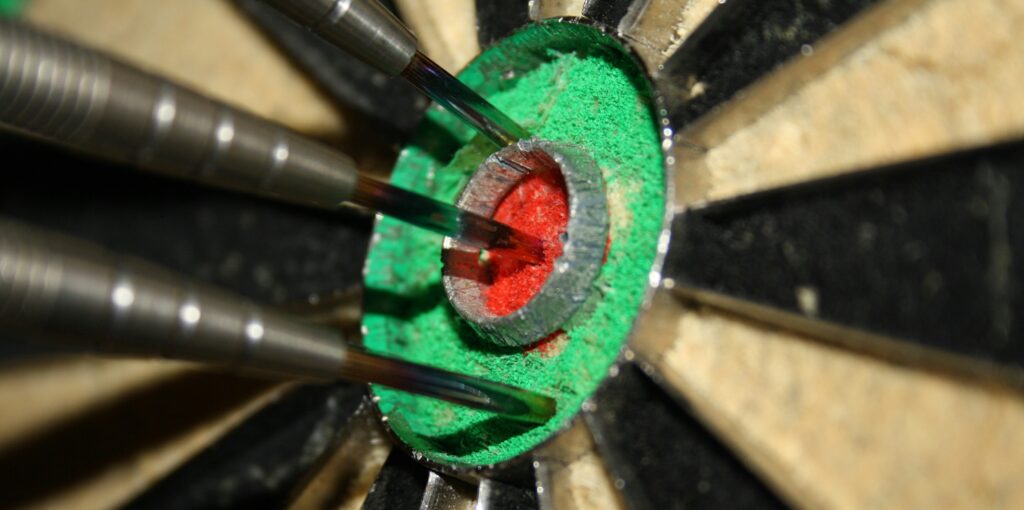
- The inner bullseye scores 50 points.
- Recording Scores: After each turn, the points scored with the three darts are added together and subtracted from the player’s total score. For example, if a player scores 60 points, their new total is 501 – 60 = 441.
Winning the Game
- Exact Zero: To win, a player must reduce their score to exactly zero. Exceeding zero results in a “bust” and the player’s score reverts to what it was at the start of their turn.
- Double-Out Rule: The final dart must land in a double segment, including the double bullseye (50 points). For example, if a player has 40 points remaining, they must hit a double 20 to win.
- Checkouts: Players often strategise to leave themselves a specific score that is easily achievable with a double. For instance, aiming for a score of 32, which can be finished with a double 16.
Strategies and Tactics
- Scoring Strategy: Players typically aim for high-scoring areas like the triple 20 (60 points) to reduce their score quickly.
- Finishing Strategy: As the score nears zero, players aim to leave themselves a finish that can be achieved with a double, often aiming for popular finishing doubles like 32 (double 16) or 40 (double 20).
Conduct and Etiquette
- Sportsmanship: Players should remain quiet and not distract their opponents during throws.
- Checking Scores: Scores should be clearly announced and agreed upon by both players before the next turn begins.
- Respecting Turns: Players should stand clear of the playing area when it is not their turn to throw.
Example of a Game
- Start: Both players start at 501.
- First Turn: Player 1 scores 100 (triple 20, single 20, double 20), reducing their score to 401. Player 2 scores 60 (three single 20s), reducing their score to 441.
- Mid-Game: Players continue to take turns, aiming to reduce their scores strategically.
- Approaching Finish: Player 1 reaches a score of 50 and decides to aim for the inner bullseye or two single 10s followed by a double 15.
- Winning Turn: Player 1, with a remaining score of 32, hits a double 16 to finish the game and win.
By following these rules and employing strategic thinking, players can enjoy a competitive and fair game of 501 darts.